
When Software Stops Waiting for Instructions
In the spring of 2026, a multinational logistics company faced an unexpected crisis. A geopolitical disruption had closed a major shipping corridor, threatening millions of dollars in delays across global supply chains. In previous years, executives would have convened emergency meetings, assembled data from multiple departments, and spent days evaluating alternatives.
This time, something unusual happened.
An autonomous AI system continuously monitoring global trade routes detected the disruption within minutes. It analysed vessel positions, inventory levels, contractual obligations, weather forecasts, fuel prices, and port capacities. Alternative routes were proposed, procurement schedules adjusted, warehousing plans revised, and customer notifications drafted before senior executives had even assembled for their first briefing.
The executives still made the final decision. Yet much of the analytical work traditionally performed by managers had already been completed.
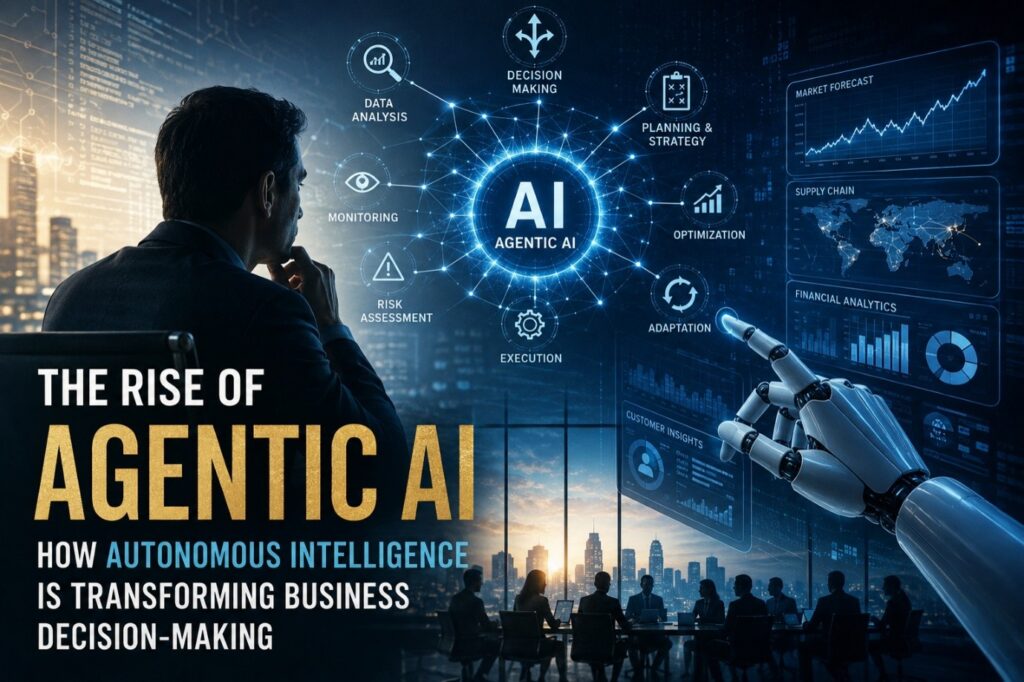
Across industries, similar stories are beginning to emerge. The rise of agentic artificial intelligence the next stage in AI evolution is quietly reshaping how organizations think, decide, and act. Unlike conventional AI systems that wait for instructions, agentic AI can pursue goals, make judgments, coordinate tasks, and adapt strategies with limited human intervention.
The significance of this shift extends far beyond technology. It challenges assumptions about management itself. For more than a century, organizations have been designed around a simple principle: humans make decisions, machines execute them. Agentic AI blurs that distinction.
The question confronting businesses is no longer whether AI can support decision-making. It is whether decision-making itself is becoming partially autonomous.
From Automation to Agency
The history of business technology is largely a story of increasing efficiency.
Industrial machines replaced physical labour. Enterprise software streamlined information flows. Data analytics improved forecasting. Machine learning enabled prediction at unprecedented scale.
Yet each technological wave remained fundamentally reactive. Systems responded to commands. Human beings identified problems, established priorities, and directed action.
Agentic AI introduces a different logic.
Rather than merely generating outputs when prompted, these systems can interpret objectives, break them into subtasks, gather information, evaluate alternatives, and initiate actions toward achieving defined goals.
The distinction may appear subtle. In practice, it is profound.
A traditional chatbot answers questions. An agentic system identifies emerging problems before questions are asked. A conventional forecasting tool predicts demand. An agentic system can adjust procurement plans, negotiate supplier alternatives, and recommend pricing changes based on those predictions.
The transition resembles the difference between having an analyst and having a junior executive. This evolution has been made possible by advances in large language models, reasoning systems, memory architectures, multimodal processing, cloud computing, and increasingly sophisticated software agents capable of interacting with digital environments.
Organizations are discovering that intelligence is no longer confined to human employees.
For the first time, businesses possess technologies capable of participating in decision processes rather than simply supporting them.
Why Businesses Are Embracing Autonomous Intelligence
The enthusiasm surrounding agentic AI is not driven primarily by technological fascination. It is driven by a crisis of complexity.
Modern organizations operate within environments characterized by overwhelming volumes of information, accelerating market shifts, fragmented supply chains, volatile consumer preferences, cybersecurity threats, regulatory uncertainty, and geopolitical instability.
Human decision-makers increasingly face a paradox. They have access to more information than ever before yet often struggle to process it fast enough to make effective decisions.
The problem is not intelligence. The problem is bandwidth.
Consider a chief procurement officer managing suppliers across multiple continents. Thousands of variables influence purchasing decisions daily: currency fluctuations, shipping costs, political risks, production delays, environmental regulations, inventory requirements, and customer demand patterns. No individual can continuously monitor all these factors simultaneously. Agentic AI offers something organizations have long desired but never possessed: scalable cognitive capacity.
Unlike human teams, autonomous systems can evaluate millions of data points continuously without fatigue. They do not forget. They do not become distracted. They do not require sleep. Businesses increasingly view these capabilities not as competitive advantages but as operational necessities.
In sectors where decisions must be made rapidly and repeatedly, autonomous intelligence is becoming embedded into the architecture of management itself.
The Invisible Transformation of White-Collar Work
Public discussions about AI often focus on job displacement. The more immediate transformation may involve the nature of managerial work.
Historically, managers spent substantial portions of their time collecting information, analysing options, preparing reports, coordinating stakeholders, and monitoring performance indicators.
Agentic AI increasingly performs many of these functions. Financial analysts are using autonomous systems that evaluate investment scenarios continuously. Human resource departments deploy AI agents capable of screening applicants, scheduling interviews, tracking employee engagement, and identifying retention risks. Marketing teams rely on systems that autonomously optimize campaigns, adjust budgets, test messaging strategies, and monitor consumer sentiment. Operations managers employ AI agents that identify bottlenecks, recommend interventions, and coordinate responses across departments.
This does not necessarily eliminate managers. Instead, it changes what management means. Routine analysis becomes automated. Strategic judgment becomes more valuable. The manager’s role shifts from processing information to evaluating recommendations, resolving ambiguities, defining priorities, and exercising accountability.
The challenge is that organizations have spent decades rewarding analytical expertise. The emerging era may place greater value on ethical reasoning, contextual understanding, organizational leadership, and decision oversight. In effect, businesses may be automating portions of management itself.
The New Economics of Decision-Making
A less discussed consequence of agentic AI concerns economics. Traditional business structures evolved partly because coordination is expensive. Companies hire managers because decisions require supervision. Layers of hierarchy exist because information must move upward for approval and downward for execution. Agentic systems reduce coordination costs dramatically. When information gathering, analysis, reporting, monitoring, and routine decision-making become largely automated, organizations may require fewer managerial layers.
The implications extend beyond efficiency. They alter organizational design.
Large enterprises historically benefited from scale because they could coordinate complex activities more effectively than smaller competitors. Agentic AI may reduce that advantage.
Smaller firms equipped with autonomous intelligence can access sophisticated analytical capabilities once available only to large corporations with extensive managerial resources. This democratization of decision-making capacity could reshape competitive dynamics across industries.
The emerging contest may not be between large firms and small firms.
It may be between organizations that effectively integrate autonomous intelligence and those that do not.
The Risks Hidden Beneath the Promise
The enthusiasm surrounding agentic AI often masks a fundamental reality: decision-making is never a purely technical exercise. Every business decision is shaped by underlying assumptions, organizational values, incentives, and trade-offs, and autonomous systems inevitably inherit these complexities. An AI agent designed to optimize delivery efficiency may prioritize speed at the expense of environmental sustainability, while a financial system focused on maximizing returns could inadvertently increase exposure to hidden risks. Similarly, a hiring agent trained on historical employment data may reproduce existing biases rather than eliminate them.
The concern is not merely that autonomous systems can make mistakes human managers make errors regularly but that they can magnify those mistakes at an unprecedented scale. A flawed judgment by an individual manager may affect a limited set of decisions, whereas an autonomous system operating across thousands of transactions can rapidly replicate and amplify the same error throughout an organization. Equally significant is the question of accountability.
When an AI-generated recommendation contributes to financial losses, regulatory breaches, or reputational damage, responsibility becomes difficult to assign. Does the burden fall on the software developer who created the system, the vendor who supplied it, the executive who authorized its deployment, or the manager who accepted its recommendation?
Existing governance frameworks were built around the assumption that humans are the primary decision-makers, with clear lines of responsibility and oversight. Agentic AI challenges these assumptions by introducing forms of autonomy that blur traditional boundaries of control. As a result, many organizations are deploying increasingly sophisticated autonomous systems faster than they are developing the governance structures needed to supervise them effectively, creating a widening gap between technological capability and institutional preparedness.
Beyond Efficiency: The Question of Trust
Business leaders frequently discuss agentic AI in terms of productivity gains, operational efficiency, and competitive advantage. Employees, however, often view the technology through a different lens. For many workers, the emergence of autonomous systems raises deeper questions about trust, authority, expertise, and professional identity. Managers who have spent years relying on experience, intuition, and institutional knowledge may hesitate to accept recommendations generated by systems whose reasoning processes remain difficult to understand.
At the same time, employees may struggle to determine when AI-generated insights should be trusted and when they should be questioned. This creates a unique organizational dilemma: as AI systems become more capable and sophisticated, their decision-making processes can become increasingly opaque, making effective oversight more challenging.
Researchers have begun describing this situation as an “oversight paradox,” in which human supervisors remain accountable for critical decisions while possessing less situational awareness than the autonomous systems they are expected to monitor. In such an environment, trust is neither automatic nor guaranteed; it must be carefully cultivated through transparency, governance, and clearly defined roles. The organizations most likely to succeed in the age of agentic AI may not be those that automate the greatest number of processes, but those that develop the most effective frameworks for collaboration between human judgment and machine intelligence, ensuring that technological capability strengthens rather than undermines organizational decision-making.
The Next Frontier of Corporate Power
Agentic AI is no longer merely a business tool designed to improve efficiency or automate routine tasks; it is rapidly emerging as a powerful institutional force capable of reshaping economic and social structures. Organizations that develop, control, or gain privileged access to advanced autonomous systems are acquiring unprecedented influence over markets, information flows, consumer interactions, and critical operational decisions.
This concentration of intelligence raises profound questions that extend far beyond the corporate sphere. Will autonomous decision-making reinforce the dominance of already powerful firms by giving them superior predictive and strategic capabilities? Could it create new barriers to competition, making it increasingly difficult for smaller players to challenge established leaders? And can regulators effectively oversee systems that continuously learn, adapt, and evolve at speeds beyond traditional regulatory frameworks?
These concerns are no longer speculative. Governments and policymakers across the world are actively examining the implications of autonomous decision systems for competition policy, labour markets, consumer rights, cybersecurity, and national security. The emerging debate bears striking similarities to earlier struggles over industrial monopolies, financial concentration, and the influence of digital platforms. Yet there is a critical difference. The resource being consolidated is not simply capital, infrastructure, or data. It is decision-making capacity itself the ability to analyse information, anticipate outcomes, allocate resources, and shape actions at a scale and speed that were previously the exclusive domain of human institutions.
The Future Belongs to Hybrid Intelligence
Predictions about technology often oscillate between utopian optimism and apocalyptic fear.
Agentic AI invites both reactions. Neither fully captures the reality emerging inside organizations. Businesses are unlikely to become entirely autonomous. Human judgment remains indispensable where values, ambiguity, ethics, politics, and social consequences intersect. Yet neither will organizations remain purely human-driven.
The economic incentives favour increasing automation of cognitive work. Competitive pressures make widespread adoption difficult to resist. The future taking shape is neither human nor machine. It is hybrid. The most consequential business question may not be whether AI can make decisions. It may be whether institutions can redesign themselves to ensure those decisions remain aligned with human objectives, social expectations, and democratic accountability.
For centuries, organizations have been built around the assumption that intelligence resides within people and systems reside around them.
Agentic AI reverses that relationship in subtle ways. Intelligence is beginning to diffuse throughout the system itself.
The real transformation, then, is not technological. It is organizational. As autonomous intelligence becomes embedded in the machinery of commerce, the boundary between management and machine grows increasingly difficult to locate.
What emerges on the other side may determine not only how companies operate, but how economic power is exercised in the decades ahead.